Private
Shared-key protection
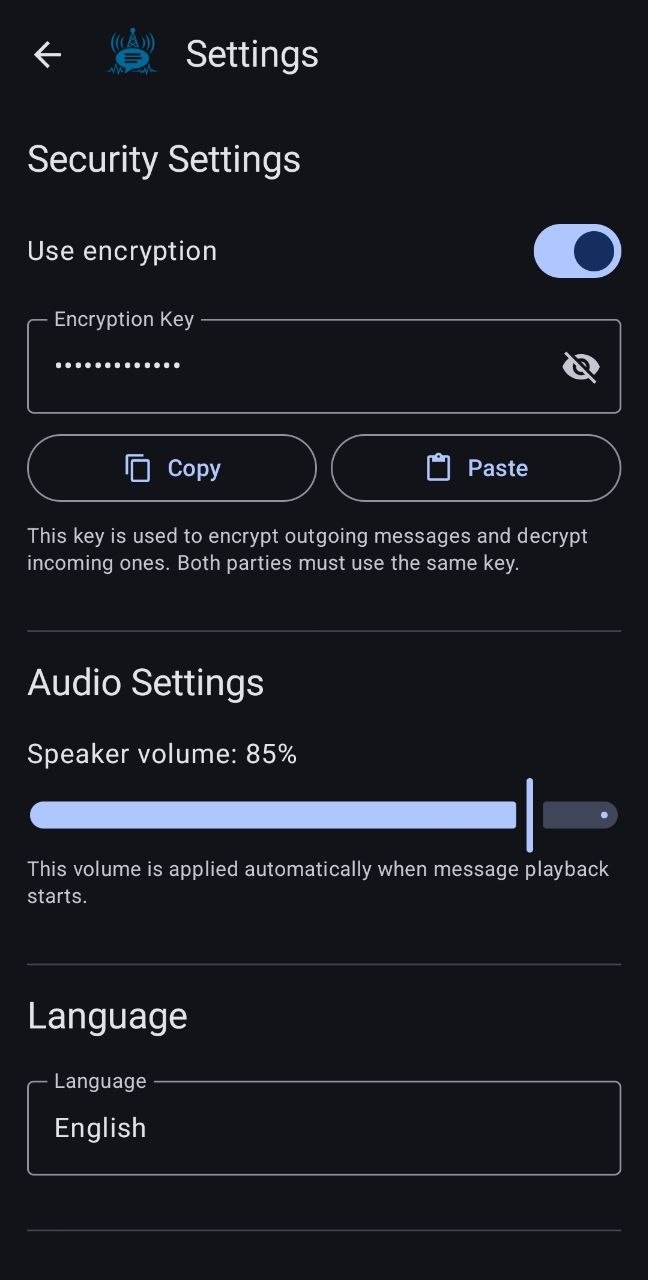
Messages can be encrypted so both sides need the same key to read the exchange.
Private messaging through sound
FSK Comm lets one device send a short message as sound and another device receive and decode it.
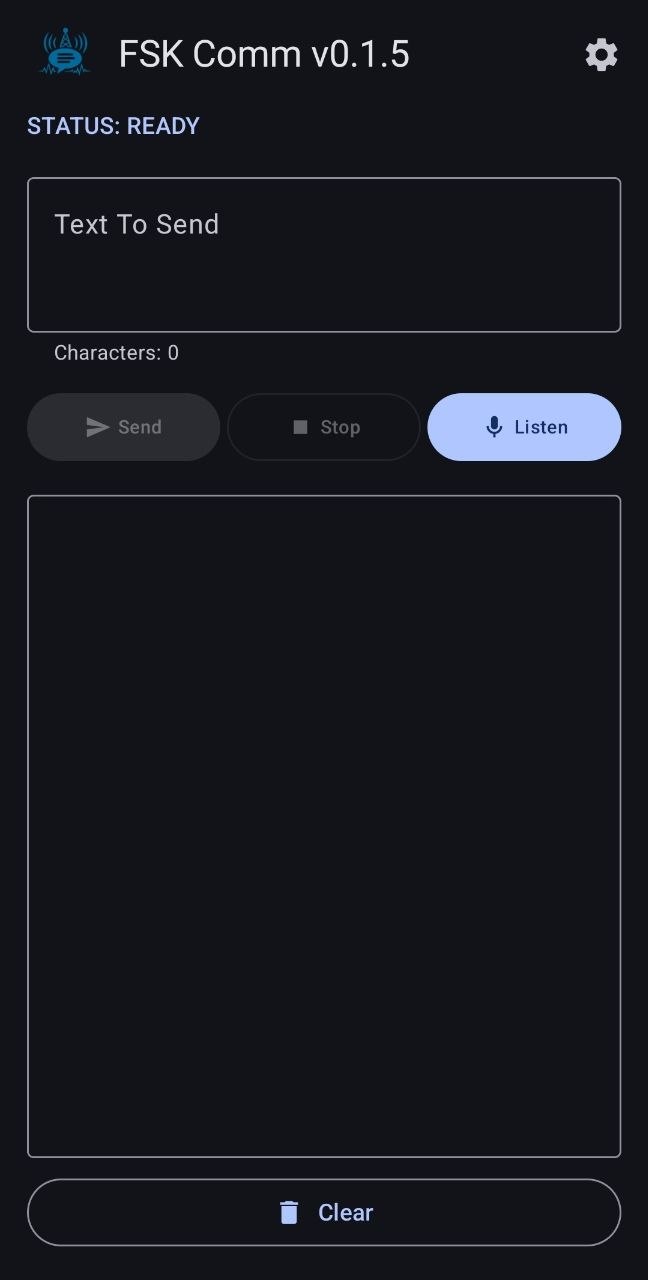
The experience stays compact: write a message, play the signal, listen on the other side, and read the result.
The stack also includes an optional keyed voice scrambler mode for analog voice experiments.
Transmission pipeline
Overview
FSK Comm is designed for short point-to-point communication where a message needs to travel through analog audio instead of a traditional network path. The project uses BFSK modulation to carry compact encrypted messages through sound, while keeping optional voice scrambling as a clearly separate secondary mode.
Private
Messages can be encrypted so both sides need the same key to read the exchange.
Practical
The app is centered on a simple send-and-listen workflow, turning text into audio and audio back into readable text.
Additional mode
An optional voice mode can scramble analog speech for practical obfuscation, separate from the primary encrypted text workflow.
How It Works
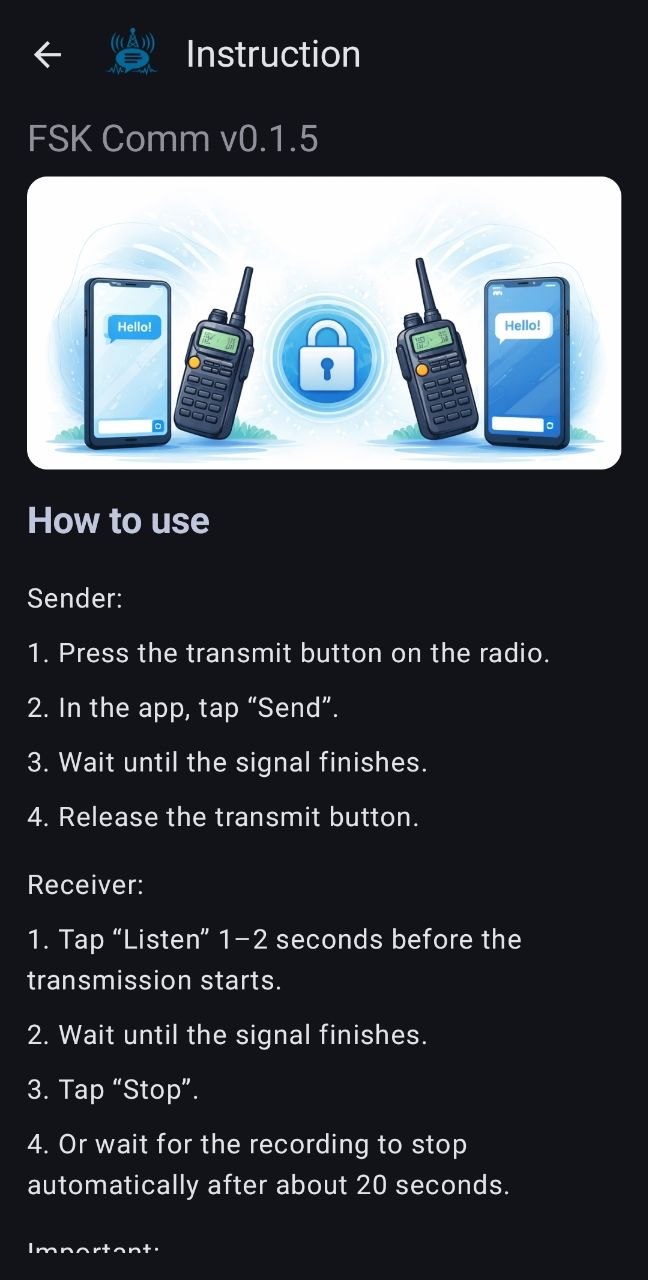
The sender enters a short message and starts transmission from the app.
The message is encoded into an audio signal that can be played and received.
The receiving side listens, records the signal, and turns it back into readable text.
A shared key is used, so the message is not readable without the correct secret.
Voice Scrambler
Alongside short-message transport, FSK Comm can also process voice audio with a keyed scrambler for analog radio and speaker-microphone experiments.
The scrambler uses voice-band processing, sync markers, and reversible audio transforms so the result stays recordable and recoverable with the same key.
This feature complements the BFSK text pipeline. It does not replace authenticated message encryption and is presented as an additional capability.
Android App